GPT-Live 四個語音智能體開發案例:Juno 如何改善慢性病患者的健康助手
Pushing voice agents further: inside four GPT-Live builds
Juno 團隊分享以 GPT-Live 建構慢性病患者語音健康助手,利用背景處理記錄與記憶及引導智能體減少對話停頓。團隊表示,交接至文字智能體的次數減少 40%,測試通話中的最長沉默由 9.3 秒降至 3.2 秒。他們先讓 290 名患有慢性病的美國成年人測試聲線,再讓 171 名新參與者比較兩款新聲線與現有聲線;勝出的新聲線獲更多人選為最喜歡,但疲憊日情境下現有聲線略佔優。

Juno: Using GPT-Live to make its voice companion feel natural to patients
By Marshall Gould, Co-founder and CEO, and Isaac Tolley, Co-founder and CTO
We’re building Juno, a personal health assistant for people living with chronic conditions like long COVID, POTS and EDS.
What we set out to build
It takes having a chronic illness to truly understand the burden it brings. It isn’t just the intense symptoms, the fatigue, the appointments or the anxiety of not knowing what’s wrong – it’s the administrative overhead: remembering that medication refill, reading the latest research, tracking symptoms and linking them to the hundreds of variables that change every day, while still trying to live a normal life.
For people living with chronic illness, especially energy-limiting conditions, these trackers are a burden - manual logging becomes exhausting, and many people stop using tracking apps, even though they help.
That’s why voice has been revolutionary. With one simple spoken phrase, Juno can log many things for you at the same time.
What’s still hard about voice
Out of the box, voice is pretty incredible. It’s the most natural way for people to communicate, but we’re still learning to get it right. A few problems remain:
- Logging a symptom or pulling in context without interrupting the flow.
- Carrying memory from text to voice without blocking the conversation.
- Holding long conversations.
I think of voice models as jellyfish. They’re fast and responsive, but they have little sense of direction of their own. They drift with whatever the user just said, and often stop to ask for confirmation. Text models are more proactive, because they can draw on a much wider context and don’t need the user to explain their situation each time. With voice, you have to do the steering.
Our approach to improving our voice agents
Logging and memory without interrupting the flow
Ask most voice agents to do something and they send it off to a tool, then wait for the answer. That wait is dead air. GPT-Live can hand work to a delegate agent, but the hand-off blocks the conversation while the answer comes back. In our first version, four in five calls had at least one of these pauses: “one moment”, then around 10 seconds of silence.
Our fix is simple. After every turn, a small, fast model (OpenAI’s Decisions API) answers two questions in the background:
- Is there anything to log, and what kind?
- What from your history matters right now?
Say “log a headache”, and Juno is told it’s been logged straight away while the save happens quietly in the background. It’s fast enough that if you ask about the headache on your next turn, it’s already saved.
The second answer handles memory. Whatever matters from your history goes into the context for the next turn, and nothing else. That matters, because a voice model works with far less context than a text model, so you have to be smart about what goes in.
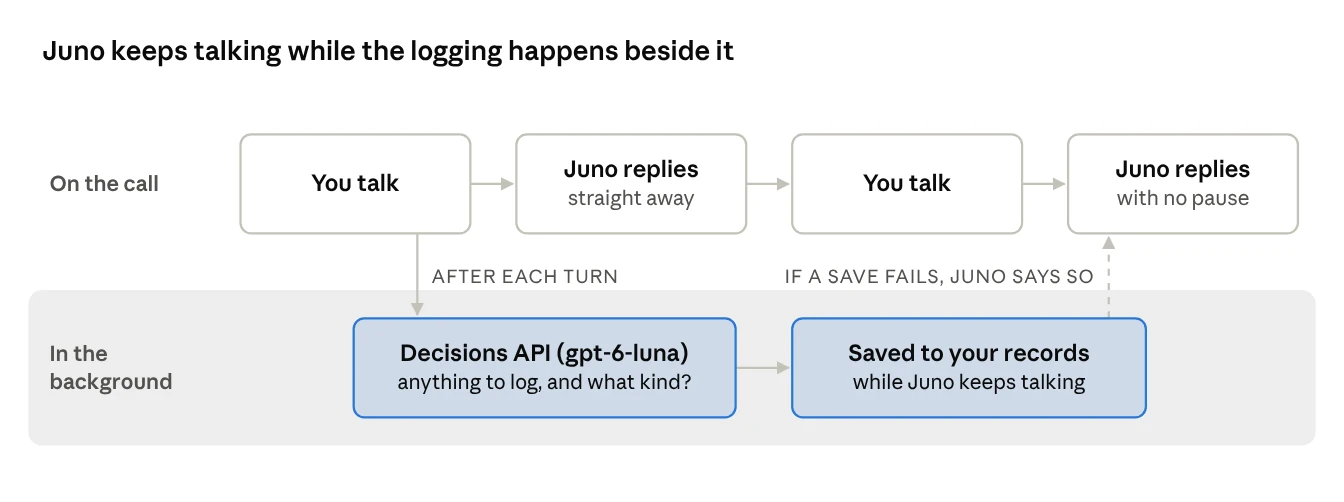
The result: 40% fewer hand-offs to the text agent, and the longest silence in a test call dropped from 9.3 seconds to 3.2. That’s the difference between an awkward wait and a natural pause.
Long conversations
Long conversations need the same care. Remember the jellyfish: the model has little sense of direction, so you have to steer it. A steering agent refreshes the context of the call, so at turn 100 Juno still knows what was said in the first turn, and knows what to bring up next if the conversation goes stale. You have to build this yourself if you want long conversations, and they matter: that’s where the patterns and trends show up that help people understand their health.
Finding Juno’s voice through live testing
Another hard problem is creating the perfect-sounding voice, and that’s easier said than done. What GPT-Live offers out of the box is a massive upgrade on its predecessors, but people still say a voice sounds like AI: can you create a voice that works for nine in ten people?
A focus group of people living with chronic illness told us our voice was slightly too slow, and a little condescending. That was important feedback, so we ran a study to improve it.
Using GPT-Live’s prompt-to-voice, we designed new voices from short written descriptions and tested them against today’s voice with 290 US adults living with chronic conditions. Everyone heard the same three lines, scored each voice, and picked a favourite, a least favourite, and the voice they’d want on an exhausted day.
Over five small rounds, we kept the best voices and rewrote the rest. Then 171 new people put today’s voice against the two best new ones.
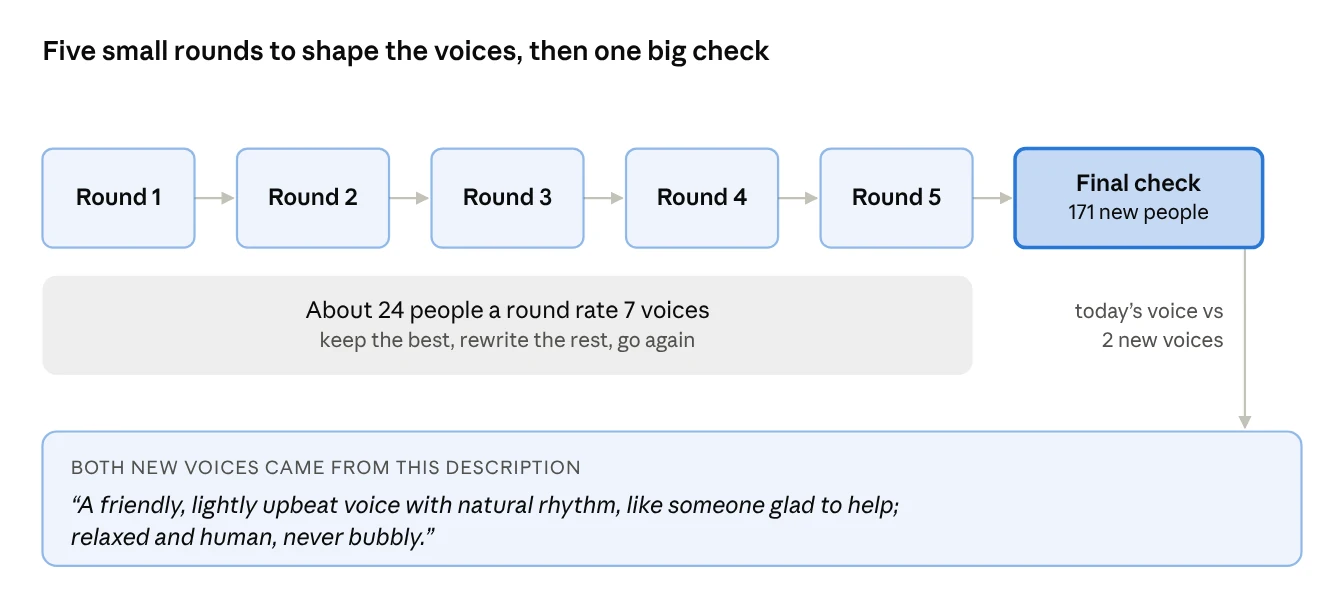
The winner was a new voice made from the description in the diagram above. In the final check, more people picked it as their favourite than today’s voice, fewer picked it as their least favourite, and far fewer said it lacked warmth.
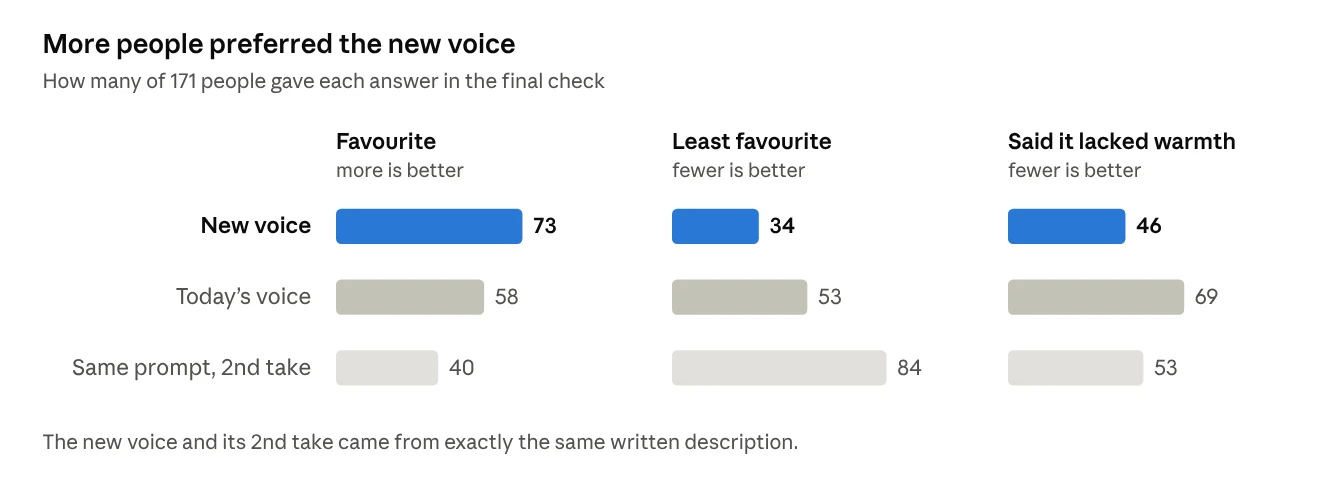
The study has limits: people heard only three lines, the scores were close, and a study isn’t a real call. Next, we’ll test the new voice on real calls with first-time callers and see whether more people come back the next day.
The exhausted-day question
We also asked which voice people would want on a day when they’re exhausted. Here, today’s voice edged ahead of the new voice. The gap is small, but it raises a bigger question: why are we so obsessed with finding one perfect voice?

Our own voices aren’t fixed. We change our tone, pace and volume depending on the situation. So what if Juno’s voice adapted to how you feel? People trust a voice more when it matches their speaking rate and loudness (Levitan et al., 2016), and GPT-Live already lets us change how Juno speaks mid-call. That’s what our follow-on study will test. You can hear every voice and see the full results at junocompanion.com/voice-study.
It’s been incredible to see what voice has unlocked for people living with chronic illness, and how much easier it has made their lives. GPT-Live is a great base model, and small changes on top of it make a real difference.
I’m Marshall Gould, founder of Juno. I built Juno’s voice alongside a team of three researchers: Isaac Tolley, Sean Lees, Dawid Wraga. Juno is a mission-first AI company helping people manage and live with chronic illness. We’re proud that most of our team live with a chronic illness. Hundreds of thousands of people now use Juno, and we’d love your help carrying on the mission. See more at junocompanion.com.
來源:OpenAI Developers:Blog · developers.openai.com