我如何以 Python、aiogram 3 和 SQLite 建立模組化雙語 Telegram 機械人範本,避免重寫樣板程式碼
How I structured a modular bilingual Telegram bot template in Python (aiogram 3 + SQLite) to avoid rewriting boilerplate
作者以 Python、aiogram 3 和 SQLite 建立模組化雙語 Telegram 機械人範本,避免每次開新專案都重寫相同的樣板程式碼。範本以 JSON 檔案管理英語和西班牙語介面,並將用戶同意條款及私隱政策的狀態儲存在 SQLite。分拆模組亦讓路由、資料儲存和背景工作互相獨立,方便配合 AI 編程助手自訂功能。


Every time I started a new Telegram bot project (for MVPs, lead generation, or service catalogs), I ended up spending the first 4–5 hours rewriting the exact same boilerplate: language switching, Terms & Privacy consent flow, SQLite setup, and basic admin tools.
To stop repeating myself, I extracted the core architecture into a clean, modular starter kit built with Python, aiogram 3, and SQLite. Here is a breakdown of how the project is structured and how I solved common boilerplate bottlenecks.
Project Architecture
Instead of dumping everything into a single bot.py file, the project is split into isolated modules so routing, storage, and background jobs stay decoupled:
text
telegram-bot-starter-kit/
├── main.py # Entry point, dispatcher & router registration
├── config.py # Environment variables & bot settings
├── database.py # Async SQLite connection & user state queries
├── handlers.py # Core user flows & menu navigation
├── admin_handlers.py # Admin-only commands (/stats, /broadcast)
├── keyboards.py # Inline & reply keyboard builders
├── scheduler.py # Background & periodic tasks
└── locales/
├── en.json # English UI strings
└── es.json # Spanish UI strings
Key Architectural Decisions
1. Lightweight JSON Localization (EN/ES)
Instead of pulling in heavy i18n frameworks for small-to-medium bots, all UI copy lives in plain en.json and es.json files with safe UTF-8 / UTF-8-BOM decoding. Adding a third language takes two minutes: duplicate a JSON file and add a button to the language keyboard.
2. Built-in Terms & Privacy Acceptance Flow
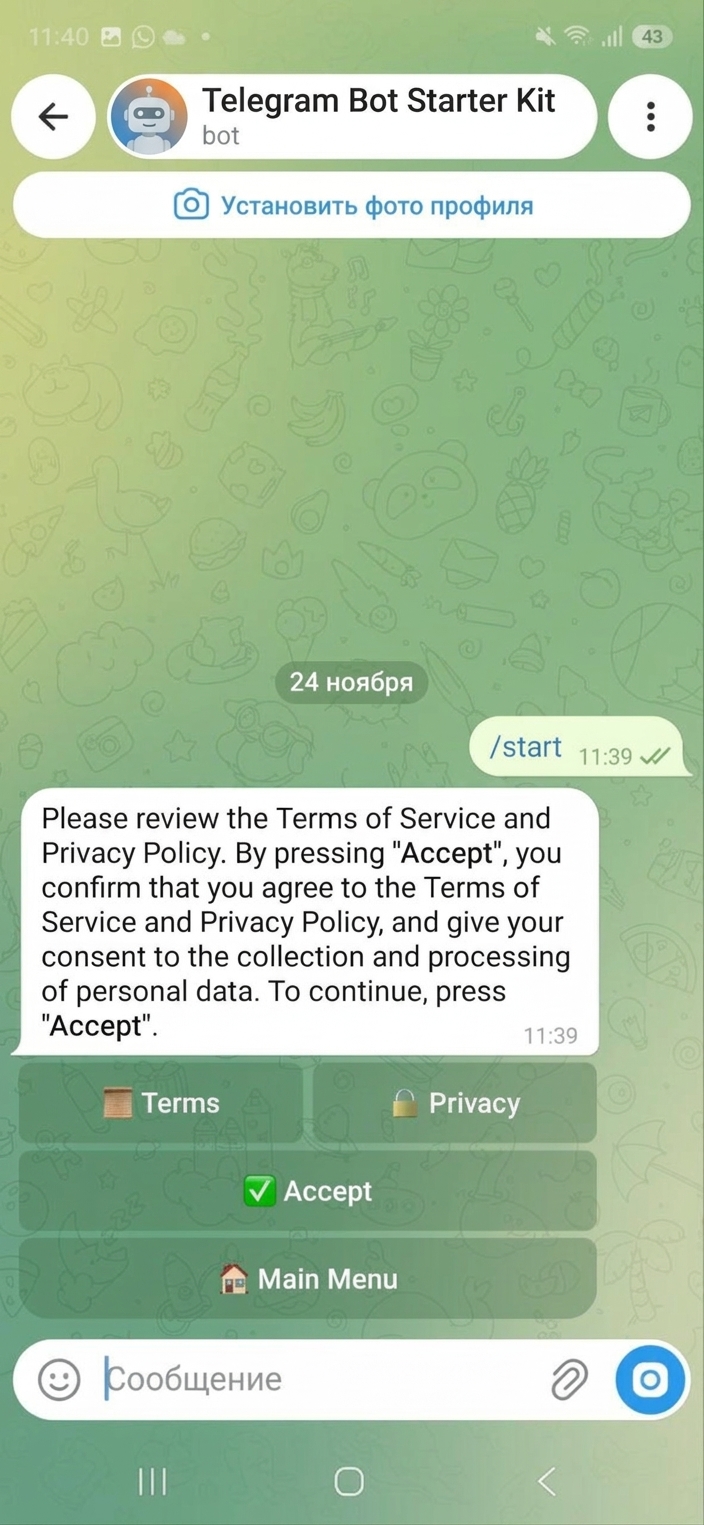
For commercial bots, logging user consent isn't optional. On /start, after choosing a language, the user gets a Terms of Service & Privacy Policy prompt. Until they accept, access to the main menu is restricted, and their acceptance status is persisted in SQLite.
3. Zero-Config Storage & Lightweight VPS Ready
Using SQLite means the bot runs out of the box on a minimal Linux VPS (even 1 CPU / 1 GB RAM) without setting up PostgreSQL or Redis upfront. Background jobs are isolated in scheduler.py, keeping user handlers fast and readable.
4. AI-Friendly Structure for Rapid Customization
Many developers now extend templates using AI coding assistants (Cursor, Claude, ChatGPT). Clear module boundaries make it easy to feed specific files to an LLM to add new menu branches without breaking existing state logic.
Explore the Structure & Source
You can check out the full architectural breakdown, setup instructions, and UI previews in the GitHub repository:
👉 https://github.com/kirillmrmv-svg/telegram-bot-starter-kit
(Note: The GitHub repository serves as an architectural showcase with documentation and core structure; the complete ready-to-run source archive is linked there on Gumroad for anyone who wants to skip the setup.)
來源:DEV Community · dev.to