使用 Amazon SageMaker JumpStart 部署及評估模型
Deploy and evaluate models with Amazon SageMaker JumpStart
AWS 的教學示範如何從 Amazon SageMaker JumpStart 部署預訓練模型,使用 SageMaker Python SDK 執行可重複的輕量測試,並在完成後刪除端點。
Choosing the right model for a specific application requires a practical way to test it with representative inputs. Amazon SageMaker JumpStart provides access to a broad catalog of already pretrained models. In this post, we show how to deploy an available model from SageMaker JumpStart, run a lightweight and repeatable performance test using the SageMaker Python SDK, and delete the endpoint when testing is complete. For supported models and available capacity, this workflow provides a repeatable evaluation path, although deployment time varies by model, instance type, quota, and AWS Region.
In 2026, SageMaker JumpStart introduced two improvements that simplify model discovery and deployment. In the Model Hub section of the Amazon SageMaker AI console, you can browse the SageMaker JumpStart catalog, view sample notebooks, and open them directly in SageMaker Studio. Pre-configured endpoint deployment options provide named configurations optimized for priorities such as low cost, low latency, or general-purpose workloads across a range of generative AI models, including Neuron-optimized configurations. Additionally, you can now go from Hugging Face model discovery to SageMaker AI deployment in a single click using the new deep link integration.
Solution overview
Our approach uses a reusable Python script that performs three steps:
- Discover and deploy a model from SageMaker JumpStart.
- Run model-specific sample prompts and measure latency, approximate output length, and single-request generation rate.
- Clean up the endpoint.
This pattern works for many compatible SageMaker JumpStart models, although payload formats, required instance types, end-user license agreement (EULA) requirements, and response schemas may require model-specific adjustments.
Prerequisites
- An AWS account with SageMaker AI permissions.
- Python 3+ with SageMaker Python SDK v3 installed (
pip install "sagemaker>=3,<4"). - Sufficient GPU instance quota for the model you want to test or request a quota increase.
Step 1.a: Discover available models
UI path to find models in SageMaker JumpStart:
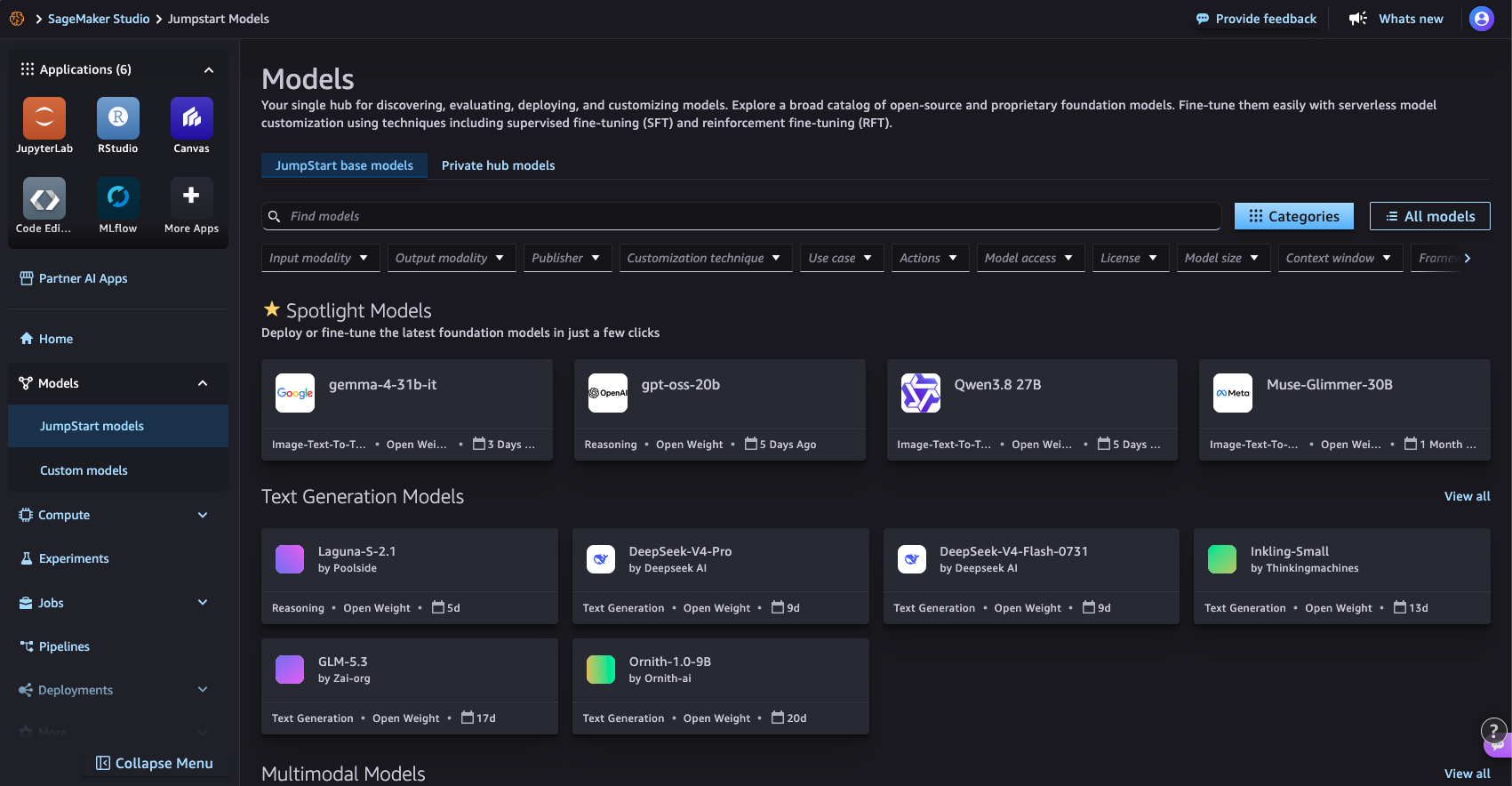
Figure 1: Browsing the model catalog on the SageMaker JumpStart Models page in SageMaker Studio
Code path using SageMaker Python SDK:
from sagemaker.core.jumpstart.notebook_utils import (
    list_jumpstart_models,
)

REGION = "us-east-1"

models = list_jumpstart_models(
    filter="task == textgeneration",
    region=REGION,
    list_versions=True,
)

print(f"Found {len(models)} text generation models")

for model_id, model_version in models[:10]:
    print(
        f" - {model_id} "
        f"(version {model_version})"
    )
Or search by model name:
from sagemaker.core.jumpstart.notebook_utils import list_jumpstart_models

ids = list_jumpstart_models(
    filter="model_id contains qwen",
    region=REGION,
    list_versions=True,
)

print(f"{len(ids)} models matched in {REGION}\n")

for model_id, version in ids:
    print(f"{model_id:<55} v{version}")
Step 1.b: Deploy the model
UI path to deploy models from SageMaker JumpStart:
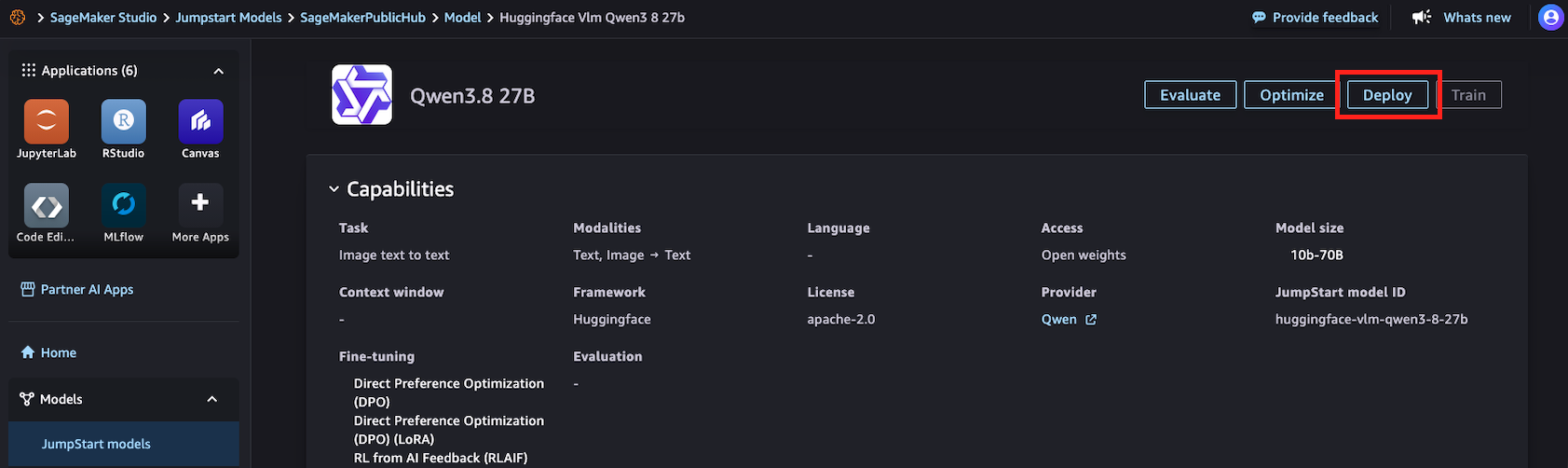
Figure 2: Deploying a model from its SageMaker JumpStart detail page in SageMaker Studio
Code path using SageMaker Python SDK:
import time

from sagemaker.core.jumpstart.accessors import JumpStartModelsAccessor
from sagemaker.core.jumpstart.configs import JumpStartConfig
from sagemaker.core.training.configs import Compute
from sagemaker.serve import ModelBuilder

MODEL_ID = "huggingface-vlm-qwen3-5-27b"
MODEL_VERSION = "1.13.0"
REGION = "us-east-1"
ACCEPT_EULA = False  # Set True only after reviewing the model terms

def get_field(value, name, default=None):
    if isinstance(value, dict):
        return value.get(name, default)
    return getattr(value, name, default)

# Resolve the JumpStart-recommended deployment configuration.
specs = JumpStartModelsAccessor().get_model_specs(
    region=REGION,
    model_id=MODEL_ID,
    version=MODEL_VERSION,
)

if isinstance(specs, list):
    if not specs:
        raise ValueError(
            f"No JumpStart specification found for {MODEL_ID}"
        )
    specs = specs[0]

recommended_instance_type = get_field(
    specs,
    "default_inference_instance_type",
)

if not recommended_instance_type:
    raise ValueError(
        f"No recommended instance type found for {MODEL_ID}"
    )

print(f"Model: {MODEL_ID}")
print(f"Region: {REGION}")
print(f"Recommended instance: {recommended_instance_type}")

start = time.time()

jumpstart_config = JumpStartConfig(
    model_id=MODEL_ID,
    model_version=MODEL_VERSION,
    accept_eula=ACCEPT_EULA,
)

model_builder = ModelBuilder.from_jumpstart_config(
    jumpstart_config=jumpstart_config,
    compute=Compute(
        instance_type=recommended_instance_type,
        instance_count=1,
    ),
)

model = model_builder.build()
endpoint = model_builder.deploy()
deploy_time = time.time() - start

print(f"Deployed in {deploy_time:.1f} seconds")
print(f"Endpoint: {endpoint.endpoint_name}")
Step 2: Run sample prompts and measure performance
from sagemaker.core.payloads import retrieve_all_examples
import json
import time

MODEL_ID = "huggingface-vlm-qwen3-5-27b"
MODEL_VERSION = "1.13.0"
REGION = "us-east-1"

example_payloads = retrieve_all_examples(
    region=REGION,
    model_id=MODEL_ID,
    model_version=MODEL_VERSION,
    serialize=True,
)

#you can re-create the endpoint pointer using the endpoint name:
#from sagemaker.core.resources import Endpoint
#endpoint = Endpoint.get(endpoint_name="<your_endpoint_name>",region=REGION)

def read_response_body(result):
    body = result.body
    if hasattr(body, "read"):
        body = body.read()
    if isinstance(body, bytes):
        body = body.decode("utf-8")
    if isinstance(body, str):
        try:
            return json.loads(body)
        except json.JSONDecodeError:
            return body
    return body

def extract_output(response):
    """Handle common JumpStart text-generation response formats."""
    if isinstance(response, list):
        response = response[0] if response else ""
    if isinstance(response, dict):
        choices = response.get("choices")
        if choices:
            choice = choices[0]
            message = choice.get("message")
            if isinstance(message, dict):
                return message.get("content", "")
            return choice.get("text", "")
        for field in (
            "generated_text",
            "output_text",
            "text",
        ):
            if field in response:
                return response[field]
    return response

results = []

for payload in example_payloads or []:
    start = time.perf_counter()
    result = endpoint.invoke(
        body=payload.body,
        content_type=payload.content_type,
        accept=payload.accept,
    )
    latency = time.perf_counter() - start
    response = read_response_body(result)
    output = extract_output(response)
    if not isinstance(output, str):
        output = json.dumps(output, indent=2)
    # This is an estimate based on whitespace-separated words.
    output_words = len(output.split())
    results.append(
        {
            "request_preview": payload.body[:50],
            "latency_s": round(latency, 2),
            "estimated_output_words": output_words,
            "words_per_second": round(
                output_words / latency,
                1,
            ) if latency > 0 else 0,
        }
    )
    print("Input:\n", payload.body, end="\n\n")
    print("Output:\n", output, end="\n\n")
    print(
        f"Latency: {latency:.2f} seconds\n"
        f"Estimated output words: {output_words}\n"
        f"Estimated single-request output generation rate: "
        f"{output_words / latency:.1f} words/second\n"
    )
    print("-" * 80)

print("\nSummary:")
for result in results:
    print(result)
Result:
Input:
{"max_tokens": 256, "messages": [{"content": "What is deep learning?", "role": "user"}], "model": "/opt/ml/model"}
Output:
Here's a thinking process that leads to the explanation of deep learning:
1. **Deconstruct the Request:**
* **Question:** "What is deep learning?"
* **Intent:** The user wants a clear, comprehensive, yet accessible definition and overview of deep learning.
* **Target Audience:** Likely someone looking for a general understanding, possibly a student, tech
enthusiast, or professional exploring the field. The tone should be informative, structured, and
not overly jargon-heavy (though key terms need explanation).
2. **Initial Brainstorming & Key Concepts:**
* What is it? A subset of machine learning, which is a subset of AI.
* Core mechanism: Artificial Neural Networks (ANNs).
* "Deep" means many layers (hidden layers).
* How does it work? Learning representations from data (feature learning).
* Key applications: Image recognition, NLP, speech, self-driving cars.
* Why is it popular now? Big data, GPU power, better algorithms.
* Pros/Cons: High accuracy vs. black box, data hunger.
3. **Structuring the Answer:**
Latency: 9.07 seconds
Estimated output words: 153
Estimated single-request output generation rate: 16.9 words/second
--------------------------------------------------------------------------------
Summary:
{'request_preview': '{"max_tokens": 256, "messages": {"content": "What', 'latency_s': 9.07, 'estimated_output_words': 153, 'words_per_second': 16.9}
Step 3: Cleanup
print(f"Deleting endpoint: {endpoint.endpoint_name}")
endpoint.delete()
endpoint.wait_for_delete()
print("Endpoint deleted")
Conclusion
This pattern works for many available SageMaker JumpStart models, but the payload format, required instance type, EULA, and response parsing may require model-specific adjustments. By using consistent test prompts and measuring latency, throughput, and output quality across models, you can compare options and select the right fit for your workload.
Try this approach with different models from Amazon SageMaker JumpStart to find the right balance of quality, speed, and cost for your applications.
References
- SageMaker Python SDK Documentation
- Benchmark and Optimize SageMaker JumpStart Deployment (blog post)
- From Hugging Face to SageMaker Studio in One Click (blog post)
- Amazon SageMaker JumpStart
About the authors

Vamsi Goparaju
Vamsi leads Go-to-Market (GTM) and Revenue Acceleration initiatives at AWS, enabling Inference and ModelOps workloads for our customers, and driving OSS Use Cases and Product features for Amazon SageMaker AI, SageMaker JumpStart, and Generative AI. With over 16 years of experience spanning AWS, Dell, and Infosys, he brings a unique blend of technical depth and business knowledge across cloud, high-performance computing (HPC), artificial intelligence (AI), machine learning (ML), and analytics. He holds an MBA from Texas A&M University’s Mays Business School.

Gula Nurmatova
Gula is a Software Development Manager at AWS based in New York, USA. She leads the engineering teams behind Amazon SageMaker JumpStart, making foundation models from providers like NVIDIA, Meta, and Mistral easy to discover, evaluate, and deploy across SageMaker and Amazon Bedrock. Prior to AWS, she held engineering and engineering management roles at RTX and GE, and holds a master’s degree in Computer Science.

Naidile Murali
Naidile is a Product Manager at AWS based in Bellevue, WA. She focuses on enhancing the AI/ML developer experience on Amazon SageMaker AI, including onboarding, IDE connectivity, and GPU capacity management. Prior to AWS, she worked as a software engineer at HSBC. Naidile holds an MBA from Georgetown University.

Dan Ferguson
Dan is a Solutions Architect at AWS, based in New York, USA. As a machine learning services expert, Dan works to support customers on their journey to integrating ML workflows efficiently, effectively, and sustainably.
來源:AWS Machine Learning Blog · aws.amazon.com