Firecrawl Alexandria 與 Treg:AI Agent 應選用哪種人員搜尋層?
Firecrawl Alexandria vs Treg: Which People Search Layer Should Your AI Agent Use?
Firecrawl Alexandria 與 Treg 都提供 AI Agent 的人員搜尋能力,但前者讓用戶指定供應商並以 Firecrawl credits 計費,後者則按供應商路由請求,從預付餘額按供應商費率扣款。
Firecrawl Alexandria vs Treg: Which People Search Layer Should Your AI Agent Use?
Firecrawl Alexandria vs Treg comes down to how you want to pay and who picks the provider. Alexandria puts 430 providers, including 12 People sources such as Apollo, People Data Labs and OpenSanctions, behind your Firecrawl key, billed in plan credits. Treg puts 123 providers behind one token, routes each people call to a provider for you, and bills a prepaid balance at the provider's own rate, with misses at $0.
Firecrawl Alexandria vs Treg at a glance
Alexandria is a provider library you call by name. Treg is a router that picks a provider per call.
| Firecrawl Alexandria | Treg | |
|---|---|---|
| What it is | Hosted catalog of providers behind the Firecrawl API | Open source tool router, "OpenRouter for agent tools" |
| Catalog size | 430 providers, 2,461 capabilities, 20 categories | 123 providers, 4,100+ tools |
| People coverage | 12 People providers, 7 of them public records | 1B+ contacts across Apollo, Hunter, Tomba, People Data Labs and others |
| Credential | Authorization: Bearer $FIRECRAWL_API_KEY |
X-Treg-Token header, never Bearer |
| Who picks the provider | You: provider + capability
|
Routed treg.people.* tools pick it; direct tools let you pick |
| Pricing model | Firecrawl credits at your plan's rate | Prepaid balance at provider rate, 0% markup |
| Discovery | Free (search, find-tools) | Free (public catalog routes) |
| Misses | Set per provider; PDL says a 404 is free | $0.00 on per-success providers |
| Free start | 1,000 credits a month, no card | $1.00 credit, once |
| Openness | Firecrawl core is open source; Alexandria is hosted | Open source on GitHub |
Catalog and coverage: who has which people data
Alexandria is wider; Treg is deeper on contact data.
The Alexandria library lists 430 providers and 2,461 capabilities across 20 categories. Its People category holds 12 providers: four commercial enrichment sources (Apollo, FullEnrich, People Data Labs, Data Legion), Particle for podcast speakers, and seven public-record sources, including OpenSanctions, the UK Sanctions List, the CMS NPI Registry and US Senate financial disclosures.

Those public records are the clearest gap. If your agent screens names against sanctions lists or checks an NPI number, Alexandria has a named tool; we didn't find one on Treg's people-search pages.
Treg's people-search page quotes 1B+ contacts across 123 providers, with Apollo, Hunter, Tomba and People Data Labs among them. Its routed capabilities cover the prospecting loop: treg.people.search, treg.people.email.find, treg.people.email.verify and treg.companies.enrich.
Our Firecrawl Alexandria explainer covers all 12 People providers in detail.
How each one routes a request
The biggest design difference is who chooses the provider.

Alexandria: you pick. Per the Alexandria docs, your agent discovers tools with POST /v2/search and sources: ["alexandria"], inspects one with find-tools, then runs it through POST /v2/scrape with an alexandria object:
curl -s https://api.firecrawl.dev/v2/scrape \
  -H "Authorization: Bearer $FIRECRAWL_API_KEY" \
  -H "Content-Type: application/json" \
  -d '{"alexandria": {"provider": "apollo", "capability": "people/search",
       "options": {"person_titles": ["VP of Sales"],
                   "q_organization_domains_list": ["example.com"], "per_page": 10}}}'
Results come back in alexandria[] with the payload under data. Some providers first return THIRD_PARTY_DATA_TERMS_REQUIRED with a requiresAction.url, and an org admin has to accept that provider's terms.
Treg: the router picks. You call a routed capability and Treg chooses the provider, cheapest first, and moves to the next one on a miss or a 429/5xx:
curl -X POST "https://treg.to/call/treg.people.email.find" \
  -H "X-Treg-[REDACTED CREDENTIAL] \
  -H "content-type: application/json" \
  -H "X-Treg-Route-Max-Cost: 0.05" \
  -d '{"full_name":"Jane Doe","domain":"example.com"}' -D -
The charge comes back in X-Treg-Cost-Micro (micro-USD). Direct tools such as apollo.people.search exist too, and don't fail over.
Want results from one known source? Alexandria's provider field pins it. Care more about the answer than its source? Treg's routing writes the fallback logic for you.
Pricing: plan credits vs provider rates
Alexandria spends the same credits as the rest of Firecrawl. Discovery is free. Execution costs the capability's listed credits. The Government and Research indexes are free up to a daily limit set by your plan. A firecrawl_feedback call within 20 minutes refunds 1 credit, capped at 10 per website and 100 per team per UTC day.
Plans from the Firecrawl pricing page, monthly billing:
| Plan | Price | Credits/month | Cost per credit |
|---|---|---|---|
| Free | $0, no card | 1,000 | $0 |
| Hobby | $19 | 5,000 | $0.0038 |
| Standard | $99 | 100,000 | $0.00099 |
| Growth | $399 | 500,000 | $0.000798 |
| Scale | $749 | 1,000,000 | $0.000749 |
Cost per credit is price divided by credits. Paid plans add credits in $5 increments: 1,000 on Hobby, 2,000 on Standard, 2,500 on Growth and 5,000 on Scale.
On November 3, the provider pages showed Apollo people/search at 0 credits and People Data Labs person/enrich at 60 credits. One PDL enrichment is $0.228 on Hobby and $0.0594 on Standard.
Treg has no subscription. It meters every call from a prepaid balance at the provider's rate with 0% markup. Misses on per-success providers bill $0.00. Your team's own provider keys are used first and never billed. New teams get $1.00 of credit once, and the cheapest email-find on the catalog starts at $0.0005.
Alexandria's credit price drops as your plan grows, which suits a team already spending Firecrawl credits. Treg's bill tracks answers, not plan size.
The same job on both: VP of Sales at 10 domains
The task: find the VP of Sales at 10 company domains and get a verified work email for each. We didn't run it; these are listed prices from November 3.
On Alexandria:
-
apollo/people/searchwithperson_titles: ["VP of Sales"]and the 10 domains inq_organization_domains_list: listed at 0 credits. - A paid reveal or enrich step for each hit. Apollo's reveal capability price wasn't on the page we read, so have your agent run
firecrawl find-tools --include-costsfirst. For scale, 10 PDLperson/enrichcalls at 60 credits are 600 credits: $2.28 on Hobby or $0.59 on Standard.
On Treg:
-
treg.people.searchwithcompany_domainandtitlefor each domain. -
treg.people.email.findfor each person found, withX-Treg-Route-Verify: trueto fold in a deliverability check. - Sum the
X-Treg-Cost-Microheaders. Email-find starts at $0.0005, and misses cost $0.00. Treg publishes one receipt from September 23, 2026: 27 people, 21 emails, 20 verified, $0.58 total.
Run both on 10 of your own domains and compare cost per verified email.
Vendor benchmarks: read them as claims
Both vendors ran their own tests.
- Firecrawl: agents using Alexandria scored 21% higher on answer quality than built-in web tools across 845 tasks, with the same model and prompts and a blind AI judge.
- Treg, 100 leads (October 2026): Treg found 92 correct emails at 94% precision for $0.53. Clay, Apollo, Deepline and Hunter found 77 to 84, for $2.21 to about $3.35.
- Treg, LessieAI People Search Bench (119 tasks): Claude Code alone scored 43%; Claude Code with Treg scored 78.2%, at half the time per list and 38% fewer tokens.
Firecrawl's test measures answer quality; Treg's measure email accuracy and cost. Neither compares Alexandria to Treg. Our Clay alternatives breakdown goes through the 100-lead table in more depth.
Let your coding agent test both with Apidog CLI
Your agent's workflow depends on a response shape staying put and a price staying under a cap. A regression suite in Apidog CLI catches a renamed field or a pricier route before your prospect list does. You write one prompt; the agent runs the commands.
Set up the CLI and its agent skill once:
npm install -g apidog-cli@latest
apidog auth login --with-token <YOUR_APIDOG_TOKEN>
npx -y skills add https://apidog.com   # pick Claude Code, Codex or Cursor when prompted
Then give your agent this [REDACTED PROMPT]
Write an OpenAPI 3 file with two Firecrawl calls (POST /v2/search with
sources ["alexandria"], POST /v2/scrape with provider "apollo", capability
"people/search", per_page 5) and one Treg call (POST /call/treg.people.email.find).
Firecrawl sends [REDACTED CREDENTIAL]earer {{FIRECRAWL_API_KEY}}; Treg sends
X-Treg-[REDACTED CREDENTIAL] and X-Treg-Route-Max-Cost: 0.05. Import it into
Apidog project , create "Firecrawl" and "Treg" environments, and
write test cases that assert status 200, data.alexandria[0].data present with
no error, and X-Treg-Cost-Micro at or below 50000. Run each case against its
environment and summarize any failures.
The agent validates each payload and runs commands like these:
bash
apidog import --project --format openapi --file ./people-search-layers.json
apidog environment create Firecrawl --project --base-url https://api.firecrawl.dev
apidog environment create Treg --project --base-url https://treg.to
apidog cli-schema get test-case-create
apidog cli-schema validate test-case-create --file ./alexandria-apollo-case.json
apidog test-case create --project --file ./alexandria-apollo-case.json
apidog run --test-case --project -e \
--env-var "FIRECRAWL_API_KEY=$FIRECRAWL_API_KEY" -r cli,junit
apidog run --test-case --project -e \
--env-var "TREG_TOKEN=$TREG_TOKEN" -r cli,junit
The run stays cheap: Apollo search showed 0 credits and the Treg cap holds each call to $0.05. The same `apidog run ... -r junit` line drops into CI; the [Apidog CLI CI/CD guide](http://apidog.com/blog/apidog-cli-ci-cd-pipeline?utm_source=dev.to&utm_medium=wanda&utm_content=n8n-post-automation) has the pipeline files, and [Apidog CLI in Claude Code](http://apidog.com/blog/apidog-cli-in-claude-code?utm_source=dev.to&utm_medium=wanda&utm_content=n8n-post-automation) covers agent setup. Apidog's free plan covers up to 4 users.
## Which should you pick?
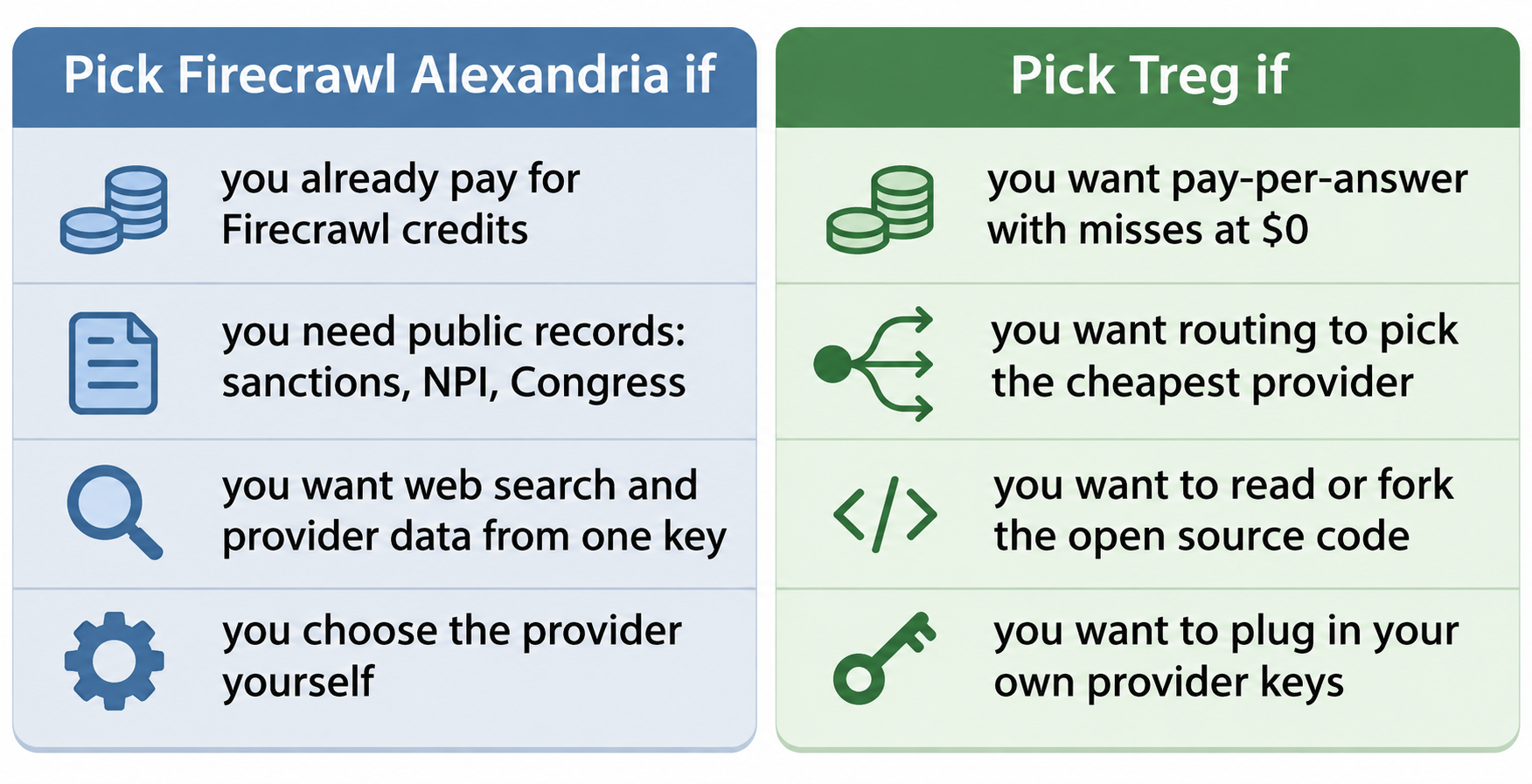
**Pick Firecrawl Alexandria if:**
- You already use Firecrawl for search or scraping and want people data on the same credits.
- You need public records: sanctions lists, NPI, Senate disclosures, House roll calls.
- You want to name the provider on every call for reproducible results.
**Pick Treg if:**
- You want to pay per answer, with misses at $0 and no plan to size.
- You want routing and fallback handled for you, cheapest provider first.
- You already hold some provider keys and want them used first, free.
- You want the code open on GitHub.
If you're new to Firecrawl, start with our [Firecrawl CLI guide](http://apidog.com/blog/how-to-install-and-use-firecrawl-cli?utm_source=dev.to&utm_medium=wanda&utm_content=n8n-post-automation).
## FAQ
**What is the main difference between Firecrawl Alexandria and Treg?** Alexandria is a hosted catalog of 430 providers you call by name with Firecrawl credits. Treg is an open source router across 123 providers that picks the provider for you and bills at the provider's rate with 0% markup.
**Which is cheaper for finding work emails?** It depends on hit rate and plan. Treg bills misses at $0 and lists email-find from $0.0005. On Alexandria you pay the capability's credits at $0.0038 (Hobby) down to $0.000749 (Scale) per credit.
**Can I try both for free?** Yes. Firecrawl's Free plan gives 1,000 credits a month with no card, and Alexandria discovery is free. Treg gives new teams $1.00 of credit once.
**Does Treg cover sanctions or healthcare provider lookups?** We didn't find sanctions or NPI tools on Treg's people-search pages. Alexandria lists OpenSanctions, the UK Sanctions List and the NPI Registry in its People category.
**Are the benchmarks independent?** No. Firecrawl's 21% gain and Treg's 100-lead and 119-task results are each vendor's own test. Run both on your data first.
來源:DEV Community · dev.to