AMD 2026 年第三季營收創季度新高,資料中心增長帶動業績
AMD Q3 2026 Earnings Data Center Growth Drives Record Quarter
AMD 公佈 2026 年第三季營收達 $13.377 billion,按年增長 45%,創季度新高。資料中心營收達 $8.546 billion,按年增長 97%;AMD 將增長歸因於 EPYC 需求強勁及 Instinct MI450 GPU 推出。AMD 預計 2026 年第四季營收約 $17 billion(±3%),以指引中位數計,按年增長約 66%,按季增長約 27%。
文章將 AMD 與 Intel 的資料中心收入及按年增幅並列,再結合 AMD 第四季指引,呈現增長動力與收入走勢。
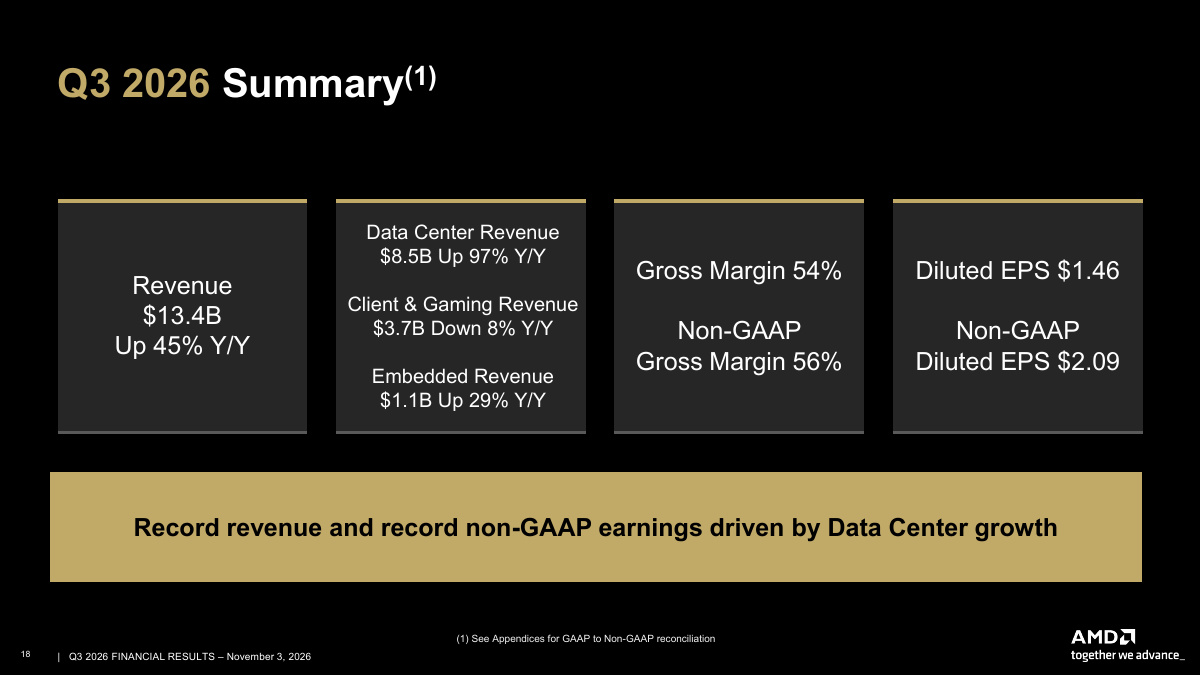
AMD posted a massive Q3 2026. Revenue hit $13.377 billion, up 45% year over year and 16% sequentially. Data Center revenue reached $8.546 billion, up 97% year over year. Embedded Revenue was up big, and client revenue fared better than Intel in many respects.
AMD Has Record Quarter Driven By Data Center
Here is AMD’s Q3 2026 summary slide. This is an enormous quarter. Embedded revenue was up 29% year over year, and yet that almost feels like a footnote.

AMD delivered GAAP operating income of $2.832 billion on revenue of $13.377 billion, with net income of $2.428 billion and diluted earnings per share of $1.46. On a non-GAAP basis, which excludes stock-based compensation, amortization of acquisition-related intangibles and other items, operating income was $3.923 billion, net income was $3.471 billion and EPS came in at $2.09.

Even the quarterly numbers were up a lot, with 16% growth on the GAAP side.
AMD’s Data Center Is Big Time
The Data Center segment generated $8.546 billion in revenue, up 97% year over year and 27% sequentially. AMD attributes this Data Center surge to strong EPYC demand and the launch of Instinct MI450 GPUs. The company says major clients, including Anthropic, Meta, Microsoft, OpenAI, and Oracle Cloud Infrastructure, are running workloads on Helios rack-scale solutions powered by these chips.

The comparison to Intel’s data center results from last week saw its quarterly revenue of $7.3 billion, up 78% year-over-year. AMD’s Data Center segment at $8.546 billion grew faster at 97%. Both companies are clearly seeing surging demand for AI infrastructure and server processors, but AMD seems to be accelerating.
Venice is coming, and we expect AMD to have clear x86 performance leadership, as Intel’s PCIe Gen6 Diamond Rapids platform, we expect, will be later in 2027. On technical merits, we expect AMD to be in a great place, and it seems like AMD is better managing its supply to get chips out.
AMD Client and Gaming Segment
The combined Client and Gaming segment saw revenue down 8% year-over-year, at $3.722 billion. Client notched up a bit, while gaming went down. Memory and NAND prices are keeping a lid on this market.

Of note, AMD said its Ryzen AI Halo Platform with the Ryzen AI Max Pro 400 series is not available, so that means Gorgon Halo? We will have our first Gorgon Halo review soon, as that machine is running benchmarks now. Somewhat notable on the slide is that AMD has three AI-related products highlighted, while Intel’s three summary bullets on its CCPG segment were focused on shortages, demand for future products, and a generic AI PC nod. AMD, with the Strix Halo platform, at least has something it can use to run reasonably large models locally, and you have to wonder if that is a driver here.
AMD’s Embedded Grows
The Embedded segment delivered $1.109 billion in revenue, up 29% year-over-year. AMD says growth came from aerospace and defense, automotive, communications and industrial end markets.

Just as a frame of reference, Xilinx’s annual revenue was something like $3.1-3.2B when AMD completed its acquisition of Xilinx. In most markets, if you grow 29% year over year and see a huge margin increase, it is time to throw a party. This seems to simply offset client’s (gaming) weakness.
AMD Q4 Guidance Points To Acceleration
AMD expects fourth-quarter 2026 revenue of approximately $17 billion plus or minus 3%. At the midpoint, that represents year-over-year growth of about 66% and sequential growth of roughly 27%.

If this quarter seems big, then next quarter seems like it will be significantly bigger.
Final Words
AMD has its Helios rack-scale infrastructure rolling out, and Venice. Ryan recently went into the Venice architecture. If AMD was ahead in many metrics with its Turin generation, then adding more cores, updated cores, and higher memory bandwidth should be a recipe for clear x86 socket leadership, at least until Intel is able to field Diamond Rapids. It will be interesting to see how much of a price premium AMD can extract for a generational advantage and first-mover status. Socket refresh generations are less exciting than the Turin-to-Venice transition, which is a major platform update (DDR5 channel count and PCIe Gen6). That also means PCIe Gen6 development, like PCIe Gen4, will likely happen more often on AMD than on Intel. Gluing chips together seems to be working out reasonably well.
來源:ServeTheHome · servethehome.com